One clear proposition
The decision is written as one sentence someone can agree or disagree with before the room opens.
A decision architecture for organisations
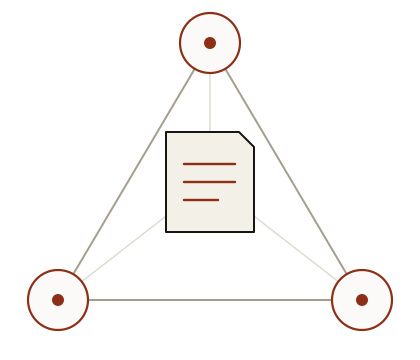
Triangle puts three relevant people around one clear proposition. The majority decides. The dissent stays with the decision. We test it on real decisions before wider adoption.
Nine people go into a room. Every one of them has a view. Ninety minutes later there is one view — the one everybody could live with.
The first person to speak sets the range everyone else argues inside. The fact known by only one person often goes unspoken. By the time a decision fails, the company has a deck, an outcome and a date — without the reasoning that led there.
That is why delegation feels risky. So the founder or chief executive stays in decisions they would rather delegate, simply because the organisation loses what it knew at the time.
The pointVote. Record. Move.
It is a small, visible structure for consequential decisions.
The decision is written as one sentence someone can agree or disagree with before the room opens.
Participants are chosen for relevant knowledge and consequence — their insight and stake matter more than their place on the organisation chart.
Each person says Agree or Disagree. Nobody needs to manufacture consensus to get the meeting over with.
The result, the minority view, the assumptions and the distribution list remain with the decision.
The argument remains human. The structure around it keeps the important part from disappearing.
Test it on decisions the company already has to make.
Every company has a different decision culture. A pilot gives you evidence from your own people, your own decisions and your own operating constraints.
One executive sponsor. One decision domain. Four to six real decisions over ninety days. One internal coordinator. Explicit protection for dissent.
We establish a baseline, facilitate the early decision rooms online, create the records, review the pattern and train an internal steward.
Whether relevant dissent becomes visible, whether executive involvement becomes more selective, and whether the organisation can reconstruct why it decided.
At the end of ninety days, you decide from evidence.
Real decisions. Private online decision rooms. A record the company owns.
The pilot begins with real decisions in a private Teams, Slack or other client-approved decision room. The proposition is issued in advance; the three people discuss it; final positions are submitted privately and revealed together.
The raw conversation remains the source record. Tools can help check completeness and prepare progress reports, and preserve what people said.
Whether the decision system is becoming more truthful, usable and less dependent on one person.
Was a minority position expressed? Was it retained accurately? The record shows whether unanimity was real or assumed.
Which eligible decisions still required the CEO? Which were delegated? When overruling decisions happened, the record shows why.
Can somebody who was not in the room reconstruct the proposition, assumptions, participants, positions and authority from the record?
Were decisions reopened? Did the same arguments recur? When something changed, could the company see what it had known at the time?
Triangle promises visible disagreement, clear accountability and organisational memory.
Three people bring relevant knowledge and consequence to the decision. The relevant disagreement, judgement and accountability remain with the record.
Companies at the point where decisions have outgrown one person’s involvement.
The founder or chief executive cannot attend every decision, and knows it. The question is whether they can delegate and stay sighted to the information, dissent and consequence around the decision.
Martin Beyst has spent years coaching senior people at Repsol, Santander, Acciona and Stellantis on how to object when objecting is expensive.
Sentence construction under pressure: how to say the difficult thing in a shape that survives the room, and how to stop an objection collapsing into agreement the moment it leaves your mouth.
Triangle came from watching what happens when organisations hear and keep what their own people know. The framework is free. The work is helping a company test it honestly on real decisions.
Bring one decision that exposed the problem and one decision coming up. We will see whether there is a credible ninety-day test.